
Trace Former Arenac County Owners
Begin with a verified parcel, not a remembered surname. Each older transfer gets its own row, so the grantor on one deed becomes the grantee you hunt in the next step back. The legal description is the continuity check.
| Transfer point | Grantor to grantee | Instrument clue | Chain use |
|---|---|---|---|
| Newest deed | Prior owner to current grantee | Date and instrument or book/page | Sets the starting identity |
| Prior acquisition | Earlier grantor to that prior owner | Same legal description | Moves back one transfer |
| Estate or court deed | Estate or ordered party to grantee | Probate or court reference | Explains a non-sale break |
| Older deed book | Historical parties as indexed | Book, page, plat and land description | Continues before web coverage |
Never fill a missing transfer from a tax name alone. A dated assessment roll can corroborate who was listed for a parcel in a given year. The recorded deed remains the core title source.
Arenac County's 1991 Owner Cutoff
The Arenac County Register of Deeds publishes online records running from February 11, 1991. Those records run to the present. LandShark is the linked modern route. Its public entry page displays no grantor, grantee, deed-type, date, or results fields. Trust only what a live search shows. A chain crossing 1991 needs another route. The office directs researchers to RECORDhub. Index books like those in the office are viewable there. Deed books 1 through 214 can be viewed or printed after account creation. An Arenac County subscription is also required. View the official recorder entry for the county's own listing.
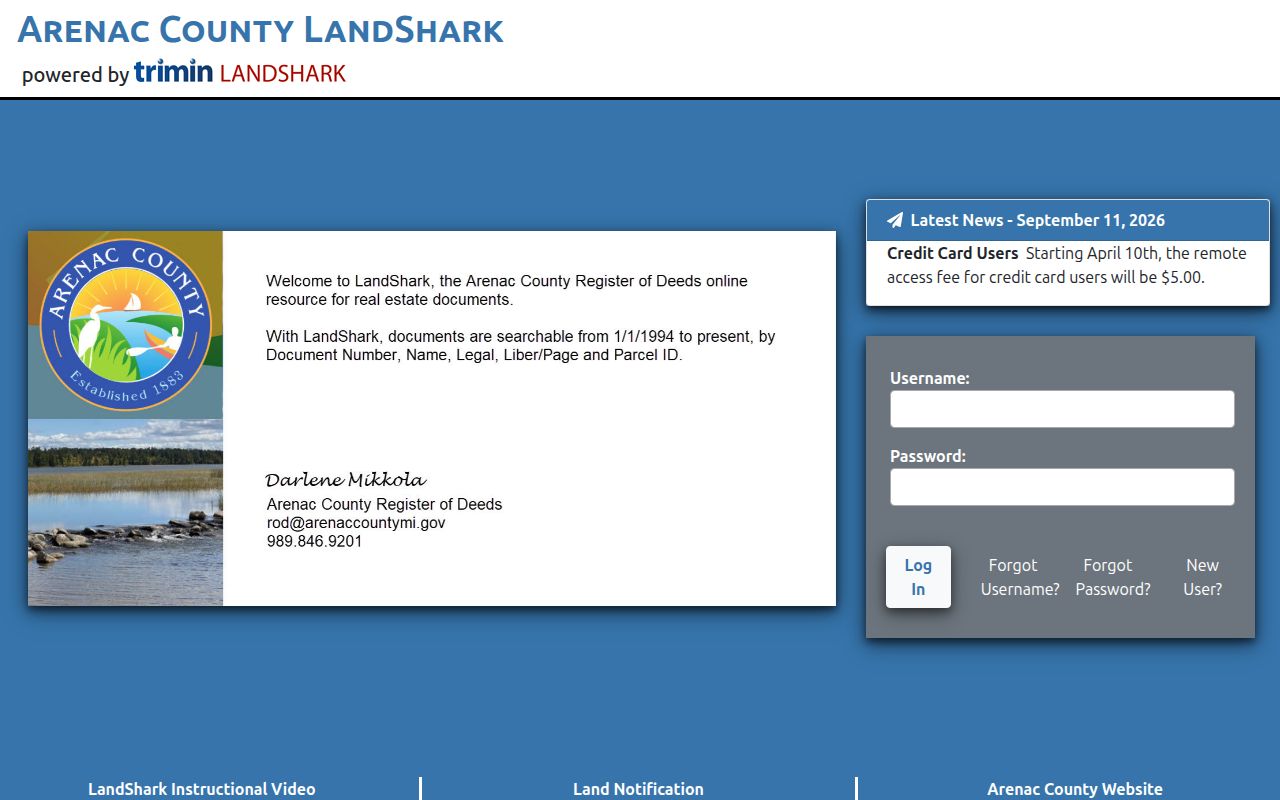
That page shows an entry shell only. Every previous-owner claim still needs an indexed instrument or a recorded image before it counts.
Reconstruct Arenac County's Deed Chain
Read the verified chain in reverse. Names alone are unsafe, since spellings drift and one party may own several parcels. Match the land description and recording references at every step.
- Find the current owner's acquisition deed with the owner listed as grantee.
- Record the grantor, date, deed type, reference and legal description.
- Search that grantor as a grantee to locate the prior acquisition of the same land.
- Repeat until the 1991 web boundary, then continue in older index and deed books.
- Grantor
- The party conveying the recorded interest.
- Grantee
- The party receiving the stated interest.
- Chain of title
- The ordered set of transfers affecting the same land.
- Legal description
- The land identity that outlasts a changed street address.
Arenac County Owners on Historic Plats
The county's Subdivision Plats table preserves named subdivisions with section, township, range, and parcel examples. A plat bridges old lot-and-block descriptions to modern PIDs. A fragment is not a full parcel record, though. The Arenac County Historical Society adds a circa-1920 plat index searchable by name, section, township, and page. Its county plat books span 1877, 1890, 1903, 1916, 1928, 1947, 1952, and 1970. Those dates help place land in a specific era.
Note: A plat index supplies a lead; it does not by itself prove that a named person held title.
Arenac County Owners in Archived Rolls
Equalization keeps past assessment rolls, owner names and addresses, title changes, maps, plats, and sales data. A dated roll shows when the owner field changed. The transfer itself sits with the recorder. The Historical Society land indexes reach further. So do the Library of Michigan county guide, the Archives of Michigan guide, and the FamilySearch Catalog, which extend the trail into maps, atlases, newspapers, probate, and land series. The Archives guide describes tax assessment rolls for 1888 to 1903. File and image access runs through those institutions.
Formation Clues for Arenac County Owners
Arenac County was first created in 1831. It was attached to Bay County in 1857 and recreated in 1883. Omer was the first county seat. Standish took that role in 1892. The land itself may never have moved. Even so, a very old trail can cross administrative lines from those earlier eras. Lumbering, rail corridors, river transport, and platted settlements shaped how older descriptions were written, so preserve town, addition, railroad, river, township, range, section, and plat language exactly. Modernizing that wording too early can hide the index entry for the next former owner.
Arenac County Estate Chain Breaks
Death interrupts a neat seller-to-buyer chain. Probate often explains the break. Arenac County Probate Court holds the estate files. A fiduciary deed or similar instrument can return the transfer to the recorder's sequence. MiCOURT results face court and public-status limits. For older gaps, the Archives of Michigan guide lists probate estate case files from 1883 to 1961 and calendars from 1883 to 1964. Those ranges show where evidence sits, though the order and its parcel link must be verified.
Log Arenac County Former Owners
A chain log keeps two people with similar names from merging into one. It also makes any gap visible. For every step, capture the party names exactly, the deed type, execution and recording dates, instrument or book and page reference, consideration only when the record supplies it, and the full legal description. Note the evidence type too. An index, image, certified copy, roll, plat, probate order, or archival finding aid each carry different weight.
Keep failed searches as well. Record the spelling tried, the date range, the portal, the parcel or land-description key, and whether an account was required. A negative LandShark search proves nothing. The chain may still cross the stated online boundary, or the land may sit under a plat, estate, entity, or variant surname.
When a historical source names a resident, building, or business, treat it as a bridge rather than a transfer. Move from that clue to a dated plat or roll. Then reach the deed book or recorded instrument. That distinction matters in Arenac County. The Historical Society offers rich local indexes but serves as a historical source, not today's title custodian. The recorder remains the office of record.
Legal Descriptions Preserve Arenac County Chains
A street address makes a friendly starting point. As a historical key, though, it is weak. Older deeds in Arenac County may describe a subdivision lot, a section-township-range tract, or land bounded by a neighbor's parcel, a road, a river, or a railroad. Copy the legal description word for word from each deed, then compare it with the prior instrument before assuming they match. Sometimes the wording shift is harmless shorthand. Sometimes it means only part of the land transferred, and the parcel number you hold today split away from a larger tract at some earlier step.
The county parcel guide, its maps, and the subdivision table translate a modern PID into the vocabulary of older land records. Keep historic plat names exactly as printed. Omer records, for instance, sometimes carry the older "Omar" spelling, and Standish and Au Gres each have their own named additions and replats. One spelling variant can be the difference between a blank index search and the correct prior deed.
Mortgages, releases, easements, covenants, and liens often sit between ownership transfers in the deed records. Log them as encumbrance events, not former owners, unless the instrument actually conveys an interest. Remember that quitclaim and warranty are instrument forms. Neither label promises every title issue was resolved. The grantor and grantee language, the legal description, and the chain context control each historical step.
When a gap appears, widen the evidence with care. Search past tax rolls to narrow a year. Probate files may explain a death transfer, court records may hold a quiet-title or foreclosure order, and plat indexes may preserve an older land name. Then return to the recorder sequence. The goal is a documented chain of recorded transfers, not a list of people who merely appeared near the property in other public sources.
Arenac County Former Owner Record Depth
The web date is not where the record trail begins. Deed books, plats, assessment rolls, probate files, and archive guides can push prior-owner work deep into Arenac County's earlier years. Availability, indexing, and image access vary widely. Cite the exact source you viewed rather than claiming one universal start date.
The Register of Deeds counter, mail, email, and telephone channels matter whenever a portal name search fails. Ask with the legal description and party-name variants. Include an approximate period and a book-and-page clue. Name the instrument you want. For one document's copy mechanics, see Arenac County deed records.
Coverage boundary. Online records begin February 11, 1991; earlier owners require the legacy books and archive route.
Former-owner records support house history, estate work, easement questions, and purchase diligence. An index-based chain is not a title opinion, and no record may be used to stalk or harass.