
Read Arenac County Deed Records
A recorded deed names the parties, describes the land, and puts a conveyance on the record. The label on an instrument sets expectations, but the complete image controls what actually happened. LandShark publishes no official deed-type menu. Treat these common categories as reading aids rather than a map of every portal option.
| Deed Type | What It Does | Common Use |
|---|---|---|
| Warranty deed | Conveys land with stated title covenants | Arm's-length transfer |
| Quitclaim deed | Conveys the interest the grantor has, if any | Family or ownership cleanup |
| Personal representative deed | Conveys under estate authority | Probate-connected transfer |
| Trustee deed | Conveys through a named trustee | Trust administration |
| Tax or foreclosure deed | Records a transfer through a statutory process | Distressed-property chain |
A mortgage or lien records an encumbrance. It does not convey the owner's full interest. Releases, assignments, easements, and plats can matter just as much to title research, so inspect the neighboring references instead of downloading only the instrument labeled as a deed.
Arenac Deed Records Start in 1991
The Arenac County Register of Deeds states that online records run from February 11, 1991 to the present. The linked LandShark application opens with username and password login controls. It posts no public grantor, grantee, date, deed-type, or legal-description form.
| Visible item | Status | Practical response |
|---|---|---|
| Username | Required on visible login | Confirm access terms with the portal or office |
| Password | Required on visible login | Do not promise anonymous image access |
| Grantor/grantee fields | Not exposed | Ask the office or inspect after authorized access |
| Deed type, date, legal description | Not exposed | Do not invent filter choices |
That gap shapes any search request. Give the office a known party, parcel, date range, and legal-description clue rather than assuming portal controls that may not exist. The LandShark recorder entry is the visible access point for Arenac County deed records.
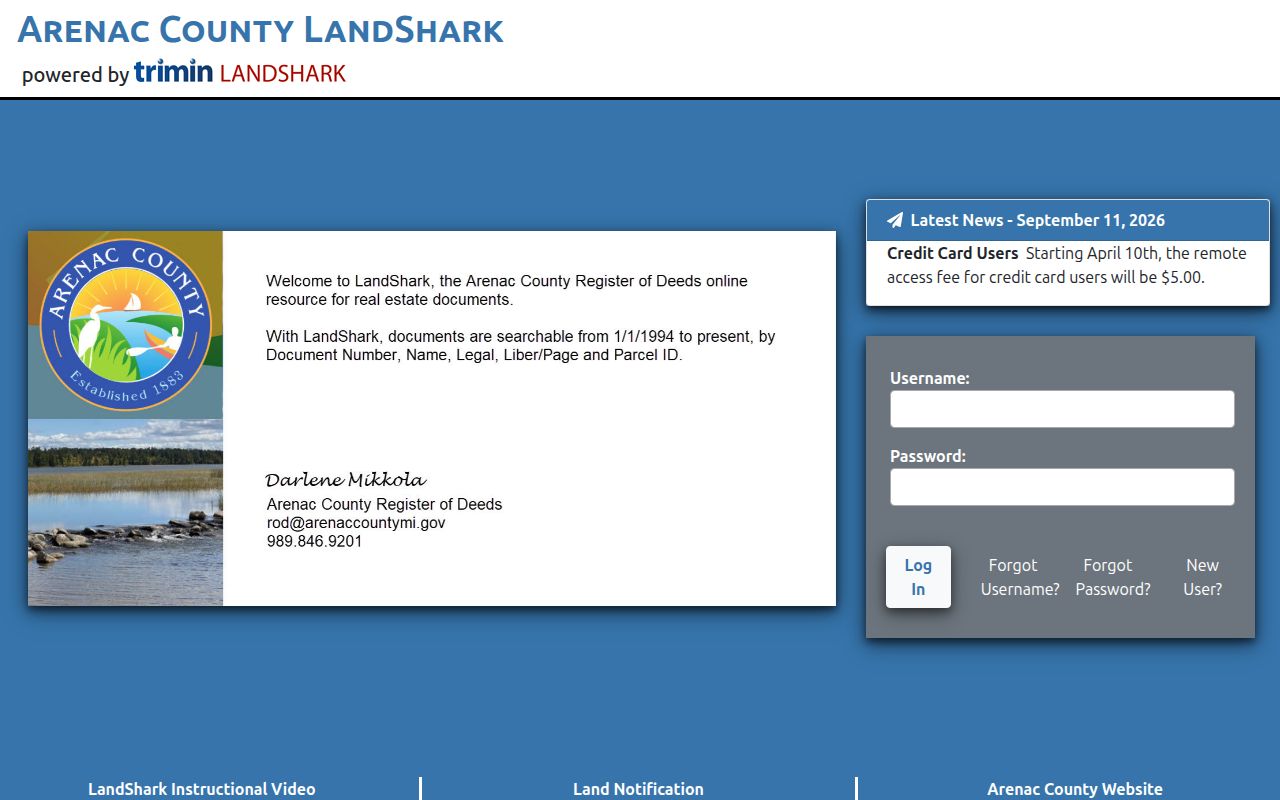
The portal page shows the route to the deed records. Its search fields sit behind a login, so do not assume what they offer.
Walk Arenac Deeds by Party
Start with the newest confirmed deed, not just the assessment name. Read its grantor, grantee, recording date, and instrument reference. Also read the full legal description. Each grantor becomes the next search name going backward. Continue until you reach your target date or the county's online threshold.
- Find the latest deed with the apparent current owner as grantee.
- Read the grantor and verify that the legal description matches the parcel.
- Search that grantor as an earlier grantee and inspect the acquiring deed.
- Repeat, watching for estates, trusts, entities, corrections, splits, and replats.
- At the February 1991 boundary, shift to the older index and deed books.
- Grantor
- The party conveying the stated interest.
- Grantee
- The party receiving that interest.
- Chain of title
- The ordered sequence of instruments tied to the same land.
- Book/page or instrument number
- The reference used to retrieve a recorded document.
Note: A party-name match is not enough; carry the land description and recording reference through every step.
Older Arenac Deeds Move to Books
Deeds that predate the online cutoff still live in the county's books. The books go back far. For those older deed records, the Register of Deeds points researchers to RECORDhub. You create an account there. Selecting a county subscription plan opens the index books. The deed books themselves run from volume 1 through 214, viewable and printable. The same historical recorder route serves the older Arenac deed-record path. The office does not state the earliest year imaged.
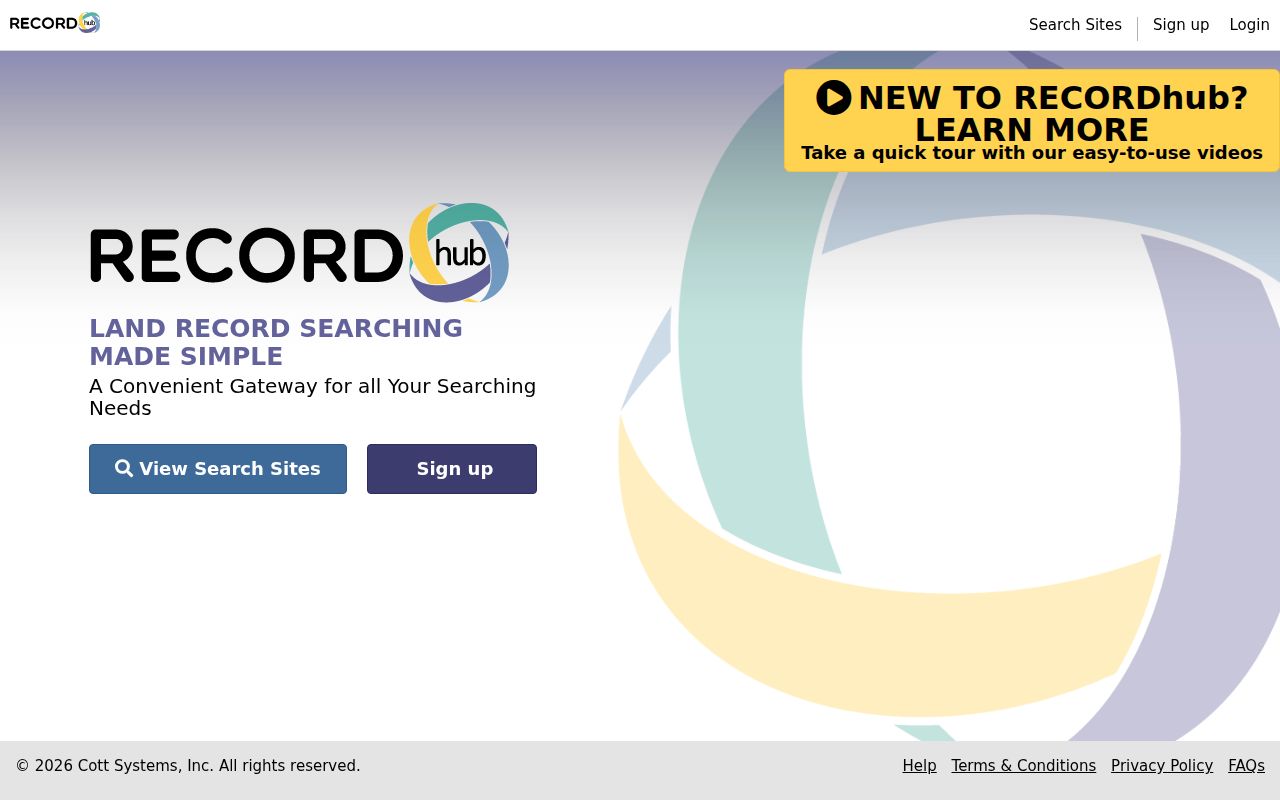
The account and subscription context explains why a pre-1992 search may need preparation or office help. A no-result in that range is expected. It does not mean the chain is broken. Search the reverse and direct indexes, then pull the cited book and page. A named subdivision or PLSS description can separate people who share a surname and tie an old deed to a present parcel.
The Arenac County Historical Society land collection adds plat books, road tours, courthouse papers, and a circa-1920 plat index. These are locating aids. The recorded deed remains the evidence of transfer.
Historic Plats Supply Arenac Search Vocabulary
The county subdivision list records names, sections, township-range coordinates, and sample parcel codes. Old wording can survive in a deed after addresses change. Search "Granton" as a historical Standish clue and "Village of Omar" alongside modern Omer. Then verify the result against the current PID.
Arenac County formed in 1883 after earlier attachment to other jurisdictions. A nineteenth-century instrument can be cataloged under predecessor geography. The Library of Michigan county guide, Archives of Michigan series guide, and FamilySearch catalog can extend the trail. Their coverage runs through maps, atlases, assessment rolls, probate, and historical deed or mortgage collections.
This layered method avoids a common mistake. It keeps a newspaper name or plat index from being mistaken for the recorded deed image. An archival finding aid carries the same risk.
Arenac Recording Fees and Transfer Taxes
The ROD page sets a $30 recording fee per document regardless of page count. This took effect October 1, 2016 under MCL 600.2657. Each additional instrument assigned or discharged adds $3. These are recording fees. They are not a quoted price for every copy type or portal subscription. The Register of Deeds office page places those dates, fees, taxes, and contact details together.
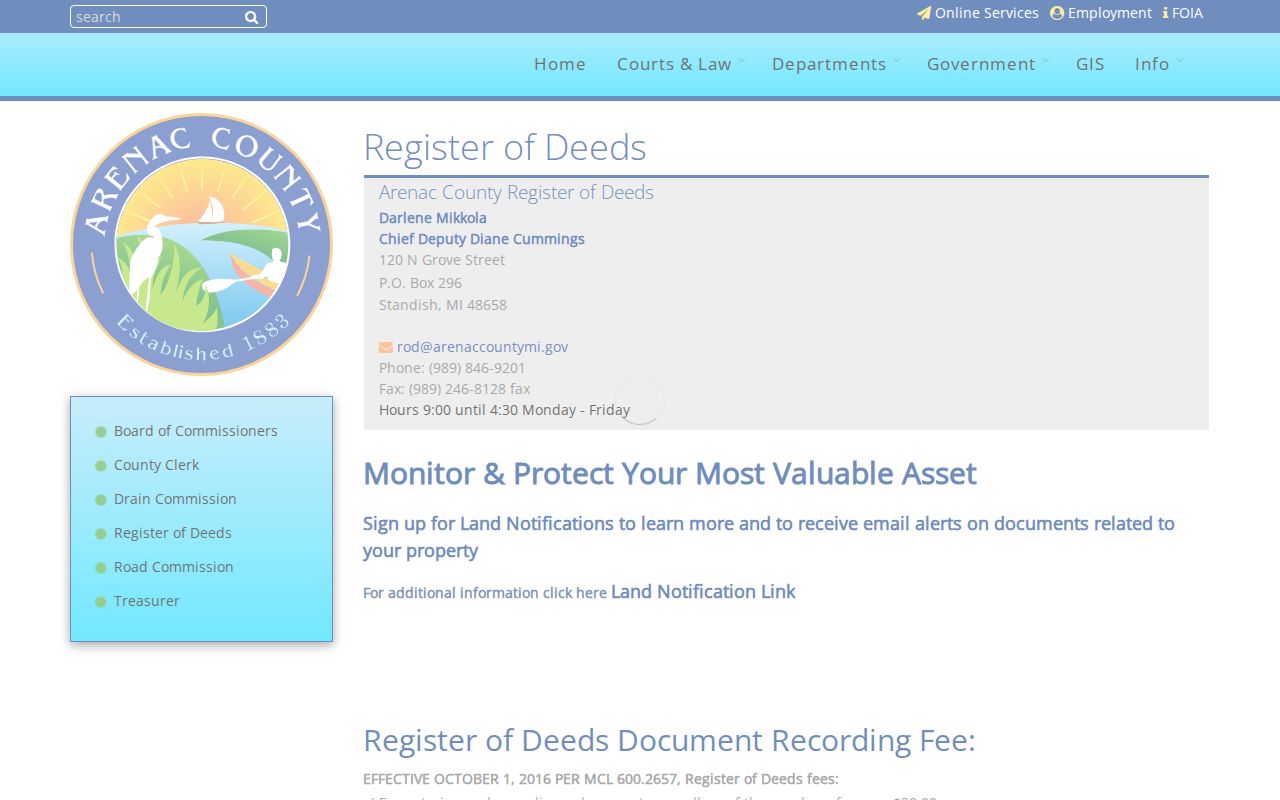
The Register of Deeds office page is the right place to recheck current terms. Check them before recording or ordering an instrument. Transfer taxes depend on the consideration or the valuation affidavit. The county rate is 55 cents per $500 or fraction. The state rate is $3.75 per $500 or fraction. When value is $100 or more, both are generally required. That holds unless an exemption is stated on the instrument. The county cites MCL 207.511, 207.525, 207.505, and 207.526.
Record the exemption text if one appears. A low stated consideration or an exemption does not by itself establish market value. It also does not prove an irregular transfer.
Arenac Land Notifications Have Limits
The Arenac County Register of Deeds page promotes a Land Notifications signup under the banner of monitoring and protecting your most valuable asset. No separate fraud-alert enrollment link is published there. Start at the official ROD page and ask the office directly how enrollment works.
A notification can warn an owner that something new was recorded against the property. It cannot block an instrument, cure a forged deed, or insure title. Michigan's foreclosure-rescue warning reinforces the point. An owner who spots an unexpected deed or mortgage filing should inspect it and contact the proper office or a legal adviser promptly.
Note: Save the recording date and instrument reference before reporting a suspicious filing; names alone can produce false matches.
Arenac Deeds Meet Liens and Probate
A clean chain of Arenac County deed records can be interrupted in many ways. A personal representative may explain a gap. So may a trust, a foreclosure, a tax deed, a correction, or a court order. Any of these can also account for an odd grantor name. Search the recorder first for the recorded instruments. Turn to probate or MiCOURT only when the transfer context demands it. Public court display varies by case type and suppression status.
The Treasurer becomes the custodian of delinquent parcels beginning March 1. The office describes a process that can end in a court-authorized sale. That sale comes after more than 24 months of delinquency. An auction listing alone never establishes the final owner of record. Pair it with the recorded deed or foreclosure instrument and any relevant court order.
A UCC filing is different again. It usually covers personal-property collateral, not the real-estate mortgage recorded in the county deed record. Keep the two systems distinct unless the filed document itself ties them together.
Capture the Full Arenac Deed Record
A complete index entry is worth preserving in full. Capture the instrument type and recording number. Note the recording and execution dates, grantor, grantee, and parcel or legal-description reference. Also record the consideration or transfer-tax indicator and image availability. Note links to prior or later instruments when the system exposes them. The public search shell may not display every field. Obtain the rest from the official entry or an office copy.
Read the entire legal description and all exceptions in the recorded image. A short index summary can omit easements, reservations, or correction language. It can also omit a reference to a recorded plat. Compare lot and block terms, PLSS coordinates, and parcel numbers against county maps. The mapped polygon is not a surveyed boundary.
If the deed names a trust, estate, corporation, or joint tenancy, record the capacity in which each party signed. That wording explains why the next grantor name may differ from the assessment roll. It can also point to probate, entity, or authority records. Those records may be needed to understand the transfer.
Obtain an Arenac County Deed Records Copy
For copies, split the work by era. LandShark covers material inside the stated online range. RECORDhub handles the older route. Both portals carry their own access terms. If either one blocks a search, the Register of Deeds will help directly at 120 N Grove Street, P.O. Box 296, Standish, MI 48658, by phone at 989-846-9201, by email at rod@arenaccountymi.gov, or in person Monday through Friday from 9:00 a.m. to 4:30 p.m.
A focused request speeds things up. Give the grantor and grantee names, the approximate date, the parcel or legal description, and any known instrument or book-and-page reference. Say whether an image, a plain office copy, or a certified copy is needed. The office publishes recording fees but no universal copy-price schedule, so ask about the copy charge when ordering.
Recorded, not guaranteed. Arenac County deed records show instruments accepted for recording. They do not establish that title is clear or reveal every unrecorded interest.
For a lawful purchase, estate, easement, or property-history project, retain the full deed image and its retrieval details. The general Arenac County property search can recover a PID before the deed request. The deed record itself remains the source for the conveyance.