
Compare Arenac County Property Value Types
Arenac County property value is never just one number. A parcel can carry a State Equalized Value, a taxable value, a local assessed figure, and a sale-related amount, and each exists for a different purpose. So pin every number to its tax or roll year and to the office that produced it. An assessment supports tax administration. A recorded deed reflects one transfer. A private appraisal answers a separate market question. Knowing which figure you need matters before you search Arenac County property records by address for a parcel.
| Value type | What the figure means | Official source |
|---|---|---|
| Assessed value | Local assessment used within Michigan's property-tax framework | Local assessor and assessment roll |
| State Equalized Value | Equalized assessment shown as SEV | County GIS and assessment systems |
| Taxable value | TV, the tax-base figure affected by Michigan rules and transfers | Assessment and tax record |
| Sale evidence | Consideration or transfer information tied to a transaction | Recorded instrument and sales data |
Write down the year every time. A value from an older roll should never be set beside a newer transfer as though the two figures answered the same question on the same date.
Arenac County Parcel Value Fields
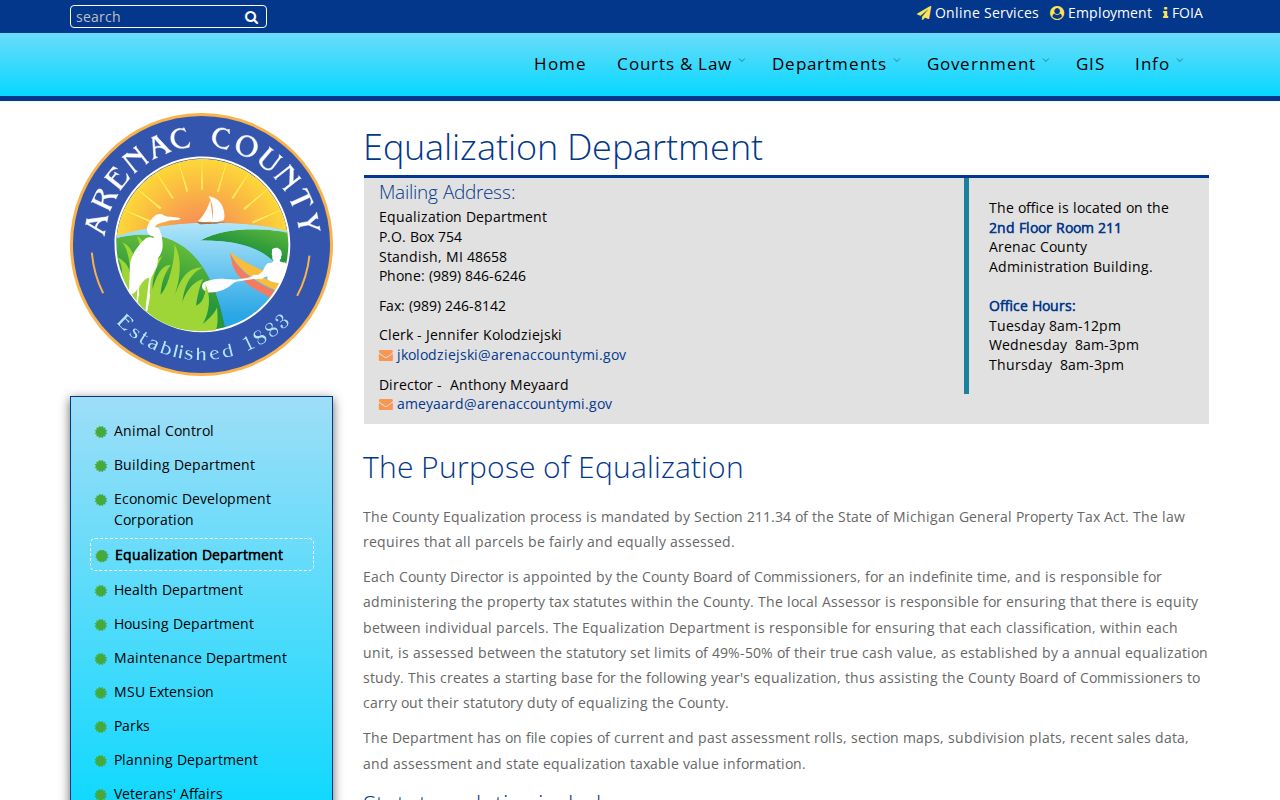
The ArenacParcels2026 REST layer exposes SEV, TV, tax and roll-year fields, property class, acreage, legal description, owner and address data, and a BS&A link. Those fields let you confirm the number belongs to the parcel you intended. The county Equalization page publishes the current value and roll resources, though it offers no live parcel-level value detail; the local roll and assessor carry the individual figures.
Open Arenac County Equalization for current value and roll resources.
Use the live parcel result and its year before quoting any assessed value.
Arenac County Property Value Roles
Arenac County Equalization keeps current and past assessment rolls and recent sales. It also holds SEV and taxable-value data, classification, exemptions, maps, plats, and parcel information. The department compiles sales and appraisal studies along with equalization factors for the whole county.
The department does not set individual assessments. That duty stays with the local assessor. The split matters when a record looks wrong. Use the countywide source for context, but take any challenge over one valuation to the local assessor and the Board of Review.
Estimate Arenac County Property Value Context
BS&A Online Arenac County accepts an address, a name, or a parcel number, with detailed-record and current-tax modes. Use it to identify the correct parcel, then interpret the values rather than copying them.
- Match the address to the PID and legal description.
- Record assessed value, SEV, taxable value, class and the applicable year.
- Check the recorded transfer and county sales information for separate sale evidence.
- Identify exemptions or transfer events before explaining why figures differ.
- Assessed value
- The local assessment within the state property-tax system.
- True cash value
- The statutory value concept against which Michigan equalization is measured.
- Taxable value
- The value used as a tax base after applicable state rules.
Compare Arenac County Post-Transfer Values
Michigan transfer-of-ownership rules can change how taxable value is treated. The county publishes a local transfer-of-ownership Q&A. The Michigan Department of Treasury offers statewide guidance on uncapping, transfer dates, and exceptions. A transfer affidavit or deed does not convert its stated amount into an assessor's current value.
Put the deed recording date beside the roll year, SEV, taxable value, and any exemption context. A clean answer names which number changed, when, and under which record. It avoids labeling every figure market value.
Note: A transfer can affect taxable value without making the recorded consideration a county appraisal of the parcel.
Arenac County Value and PRE
The Michigan Principal Residence Exemption lowers the school operating millage on qualifying property. It does not rewrite the parcel's market or assessed value into a sale estimate. Keep PRE status next to the value fields whenever the tax effect is in question.
Use the Michigan Treasury PRE guidance for filing and appeal details. A parcel's exemption status comes from its assessment record. It does not come from an assumption about who owns it.
Arenac County Value Snapshots
Dated 2024 aggregate snapshots cover the county's incorporated cities. Omer, for example, shows a total value of $10,681,000. That splits into $9,335,500 in real property and $1,345,500 in personal property. Totals like that describe one citywide report at one moment. They do not describe the worth of a single lot.
Omer publishes no multi-year official trend series. The same caution holds across Arenac County: never calculate appreciation from one aggregate report or mix a city total with a parcel value.
Separate Arenac County Value from Tax
A value field explains the base. But a tax bill also turns on taxable value, exemptions, and the millage that applies. The County Treasurer takes delinquent real-property taxes beginning March 1. He runs the payment and reversion routes, yet those records answer payment status, not market worth.
For bill mechanics, delinquency, exemptions, and appeals, use Arenac County property tax records. The value question stops at what the numbers mean and where to verify them.
Compare Arenac County Values by Year
A sound comparison uses one parcel and labels each year. Record the PID, class, acreage, and exemption status. Record the assessed value, SEV, taxable value, and the roll or tax year. If the land was split, combined, improved, damaged, reclassified, or transferred, say so. Describe any rise or decline only after that. Otherwise the comparison may join unlike parcels or unlike value concepts.
Equalization holds current and past rolls plus recent sales. That makes it the countywide context source when a prior-year view is not obvious. The local assessor remains the authority on how one assessment was determined. Where a published value was contested, a Board of Review record or Michigan Tax Tribunal matter may document the challenge. It may also document the outcome.
Sale evidence needs the same discipline. Transfer taxes rest on consideration or a valuation affidavit under the county recorder's guidance. But exemptions can apply. And the figure still describes a transaction rather than an appraisal. Report the recorded source and its date. Never infer current market worth from a lone historic sale. The same goes for a citywide total or a change in taxable value.
Why Arenac County Values Disagree
Two numbers can both be right. SEV sits inside the equalized assessment framework. Taxable value follows Michigan tax rules instead. A deed's consideration records one specific transfer. Dates, exemptions, uncapping, class changes and parcel changes can pull these figures apart, so each number only means something once it carries a label for source, year and purpose. Label first, then compare.
A recorded sale can carry limits as market evidence. Transfer taxes, as the Register of Deeds explains, generally rest on the value or consideration stated in the instrument or the valuation affidavit, subject to statutory exemptions. That recorder calculation is not an Equalization appraisal. Treat it as recorded transfer evidence. Compare it with county sales studies only in the matching period and property class. Evidence and appraisal serve different questions.
Trends break when the property itself changes. New construction, demolition, acreage changes, a parcel split or combination, a zoning shift, an exemption, or a transfer can each alter the record. County GIS supplies geometry and acreage clues. Local assessment files explain how an individual parcel was treated. A city zoning approval or building form adds context, but neither sets SEV or taxable value.
A figure that looks wrong deserves quick handling. Preserve the dated page. Then contact the local assessor before the appeal deadline passes. Michigan offers Board of Review forms and a Tax Tribunal route, though the right path depends on the issue and its timing. Bring the parcel ID, the notice, the roll year, the claimed error, supporting sales or property facts, and any prior decision. The public records show the official figures, the appeal record shows how a challenged value was handled, and dated notices should be kept because later portal values may stop showing the earlier figure under review.
Arenac County Assessed Value Limits
An assessed value promises nothing about a sale price. It cannot establish title or settle a boundary. Instead, it is a public administrative figure that carries a year and a statutory setting. A recorded sale is one transaction, and a listing or offer is not an official county value.
Value versus price. An Arenac County assessed value is not a forecast of the price a buyer and seller will agree to.
A record error belongs with the local assessor. Follow the Board of Review route from there. A formal market conclusion instead calls for a qualified appraiser, with the appraisal's effective date and purpose clearly identified.