
Inside Arenac County Property Tax Records
Three custodians share the work behind Arenac County property tax records. They are local assessors, county Equalization, and the Treasurer. The assessment side names the parcel, its classification, State Equalized Value, taxable value, and any exemptions. Assessed and taxable values appear here. The tax side shows the year's summer, winter, and village charges along with payment status. Equalization maintains countywide roll information. Each local assessor determines an individual assessment, and the Treasurer handles delinquent real-property taxes. Legal-description clues sit on the assessment side too.
| Field | What It Shows | Where |
|---|---|---|
| SEV | The equalized assessment, generally tied to one-half of true cash value | Equalization / local assessor |
| Taxable value | The value to which millage is applied, subject to Michigan caps and uncapping rules | Assessment roll |
| PRE and other status | Whether a principal-residence or other qualifying treatment is reflected | Local assessor / state forms |
| Tax-year links | Separate summer, winter, and where applicable village bill links by year | BS&A / ArcGIS parcel record |
| Delinquent status | Unpaid prior-year real taxes, payment and foreclosure path | Arenac County Treasurer |
The official ArcGIS parcel layer carries SEV, taxable value, both prior-year figures, transfer and sale-related fields, and separate tax links. A tax bill is not a market appraisal. A recorded sale amount is not automatically the current taxable value either. Read the year label and the field name. Never flatten every figure into one "property value."
Arenac's Parcel Tax-Year Fields
The ArenacParcels2026 service publishes many year-and-season tax links. Its schema holds 2026 summer and village links. Alongside those sit 2025 and 2024 winter, summer, and village fields. That spread matters when a payment screen meets an assessment record. The newest link may miss some installments or taxing units.
| Recorded field | Use in a tax review |
|---|---|
| PID / PROPERTY_A | Confirm parcel number and situs before comparing bills |
| SEV / PREV_SEV | Compare the equalized value across the available snapshots |
| TAXABLE_V / PREV_TAXA | Separate capped taxable value from SEV |
| Tax_Info and year links | Open the appropriate BS&A tax detail without losing the parcel key |
| SALE_DATE / SALE_AMT | Flag a possible transfer without treating sale price as the tax base |
Save the PID, tax year, and source date first. If a portal refresh changes what appears later, the saved identifiers keep the comparison clean.
Reading the Published Value Detail Carefully
The county Equalization page describes the office's duties. It maintains assessment rolls, section maps, plats, sales studies, SEV, and taxable-value information.
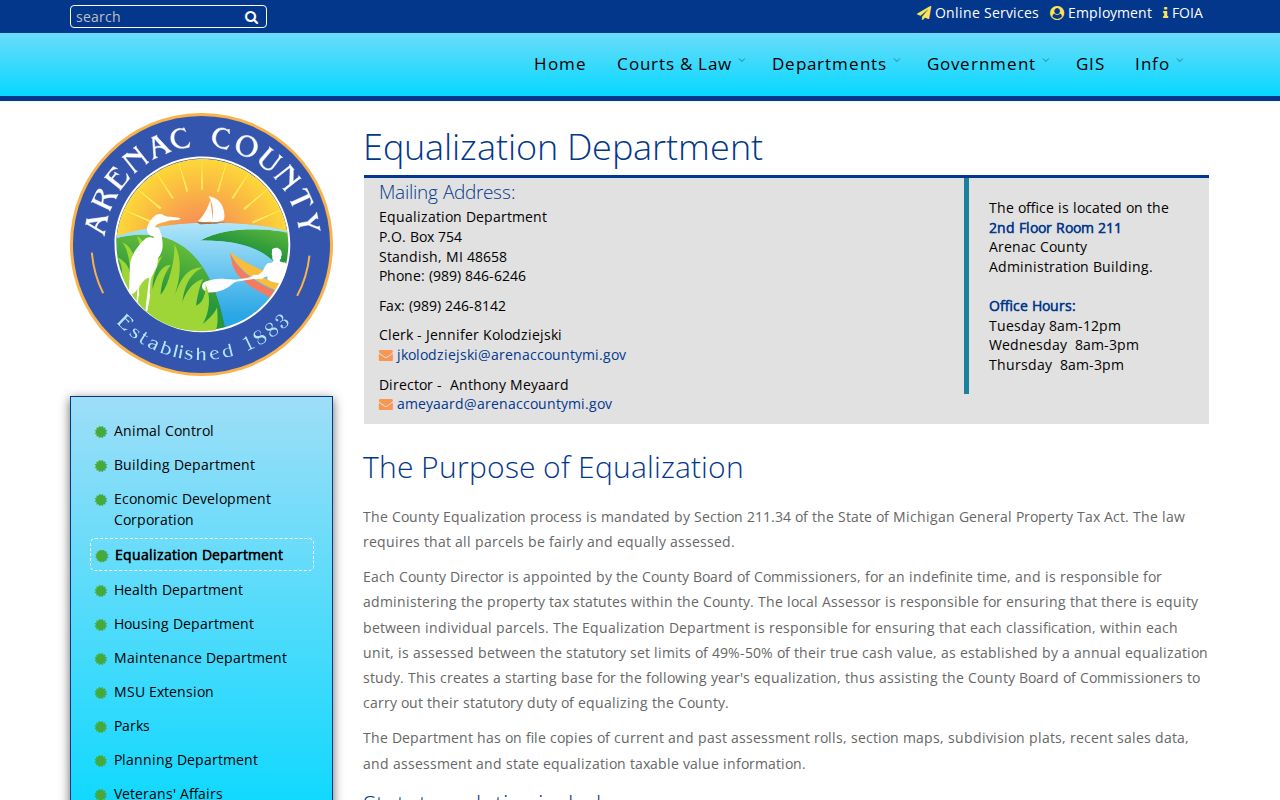
This is an office-level source, not a live parcel card. It establishes responsibilities and access rather than any single property's current value.
Note: The local assessor determines an individual assessment even though county Equalization maintains and reconciles countywide information.
Look Up an Arenac Tax Bill
Begin with the BS&A Online Arenac County collection. It accepts address, owner-name, and parcel-number lookups, with detailed-record and current-tax modes. Search mechanics belong in the property-search guide. For tax work, confirm the parcel first, then open the correct tax year.
- Search BS&A by address, name, or the exact PID; match the situs and legal-description clue.
- Choose the labeled tax year and season instead of assuming the first link is the complete bill.
- Compare SEV, taxable value, classification, PRE status, and transfer information on the assessment side.
- If a prior-year real-property tax is unpaid, move to the Treasurer rather than relying on a current local bill screen.
- SEV
- The equalized assessment, distinct from the capped taxable value.
- Millage
- The rate applied to taxable value, expressed in mills.
- Principal Residence Exemption
- Michigan treatment that exempts a qualifying principal residence from the local school operating millage.
- Tax lien
- The governmental claim arising from unpaid property taxes, with statutory forfeiture and foreclosure stages.
When Arenac Taxes Become Delinquent
The Arenac County Treasurer handles delinquent real-property taxes, tax reversion, and related land-bank links. Current taxes stay local through February's last day. After that, delinquent real taxes go to the county. Partial payments are permitted. Taxes must be paid in full, though, to avoid added fees, interest, and eventual foreclosure.
Michigan's county foreclosure process sets the notice, forfeiture, petition, redemption, auction, and title framework. A tax-sale listing proves no final owner. Pair it with Treasurer status, the recorded deed or foreclosure instrument, and any circuit-court order. A redemption or surviving interest can change everything.
Note: Label the tax year and installment beside every amount; Arenac's service exposes several seasonal and village links.
Arenac's Tax Payment Cutoff
The official Treasurer page posts the current payment cutoff.
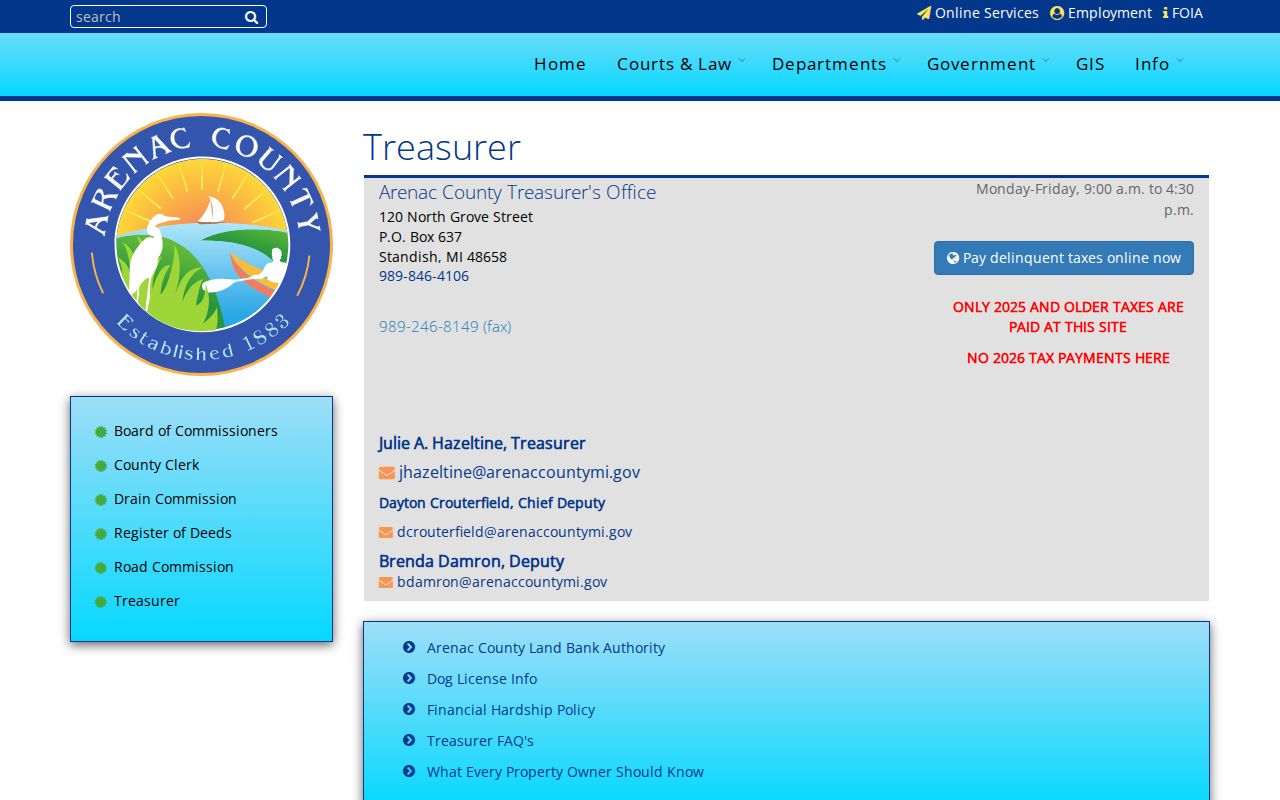
This source points the question to the right office. It cannot replace a parcel-specific receipt or a dated payoff amount for a payment or status question.
PRE, Transfers, and Taxable-Value Uncapping
The Michigan Principal Residence Exemption program lays out claim, rescission, and appeal routes. PRE affects local school operating millage. PRE is not a blanket exemption. Arenac Equalization also links transfer-of-ownership guidance. A qualifying transfer can uncap taxable value in the next assessment cycle, so a buyer's later bill may not match the seller's prior taxable value.
Compare the recorded transfer date and the property-transfer affidavit. Weigh assessment-year values and PRE status alongside them. Some transfers fall within statutory exceptions, and a surname change or deed type alone does not prove uncapping. For an individual decision, use the local assessor and the official transfer guidance rather than estimating from the GIS display.
Three different numbers. Sale consideration documents a transaction, SEV reflects equalized value, and taxable value is the figure used with millage. They should not be substituted for one another.
Request Offline Arenac Tax Records
Online access is only one channel. Equalization can supply rolls, maps, sales studies, and parcel information. The local assessor holds the individual assessment. The Treasurer answers delinquent-tax questions. BS&A may not show the needed year. Ask by phone, mail, or at the counter. For an identifiable existing county record, send a written request under the Michigan Freedom of Information Act, MCL 15.231 et seq. Describe the parcel, year, record type, and desired format. The normal initial response period is five business days, with a possible ten-business-day extension.
A request for "all tax information" is hard to route. Ask instead for the 2024 summer bill and payment ledger on a specified PID. FOIA reaches existing nonexempt records. It does not require an office to build a new valuation analysis.
Build an Arenac Assessment Evidence File
Build the evidence file around one parcel at a time. Start with the notice and property card. Add the current and prior SEV, taxable value, classification, acreage, and sale history. Photographs help. So do genuinely comparable sales, not just nearby listings. GIS acreage and equalization acreage sometimes disagree. Keep both figures. Attach the deed or survey instead of picking one quietly.
The Michigan Board of Review uses Form 618/L-4035. Each city or township assessor sets its own dates and procedures. Tribunal deadlines vary by classification and current rules. Go by the date printed on the notice and confirm the route right away. A transfer, a PRE denial, a valuation dispute, a classification question, and a clerical error are different issues. Each one can follow a different path through the county.
Read Arenac's Delinquency Timeline
A current local bill, county delinquency, forfeiture, foreclosure petition, redemption, and auction are distinct stages, not interchangeable labels. Record the tax year, the source date, the amount, and the exact named stage whenever you pull Arenac tax records.
| Stage | Source | Question |
|---|---|---|
| Current collection | Local treasurer / BS&A | Is it payable locally? |
| County delinquency | Arenac Treasurer | What prior-year taxes remain? |
| Forfeiture or redemption | Treasurer / state notices | What deadline applies? |
| Foreclosure or auction | Court and Treasurer | Was title entered or property offered? |
An auction listing can still be redeemed later. Before treating it as proof of ownership, confirm the latest custodian record and the recorded instrument in the Arenac deed records.
PRE Dates in Arenac Tax Records
Michigan Treasury guidance sets two key dates. June 1 applies to a principal-residence claim affecting summer tax. November 1 applies to a claim affecting winter tax. A late-claim route may reach the current year plus three prior years. That route remains subject to program rules. A PRE denial can be appealed to the Michigan Tax Tribunal within 35 days. These dates govern exemption administration only, so they do not replace the separate valuation-appeal calendar.
Keep the paperwork together. File the claim or rescission form, the proof of filing, the assessor decision, the bill showing the millage treatment, and any Tribunal petition in one place. Keep those papers together in one place. When a parcel changes hands, compare the property-transfer affidavit against the PRE status. Never assume one filing controls the other. The county tax roll shows what was coded for a given year. The local assessor and Treasury determine whether the treatment is correct.
Cross-Check an Arenac Tax Bill
Before paying or appealing, match at least three identifiers. Check the PID, a situs or legal-description clue, and the owner or mailing field. Then confirm the tax year and whether the line is summer, winter, or village. This habit catches errors from similarly named roads. It also catches neighboring lots under one owner, and stale bookmarks to an earlier season in an Arenac property search.
When the assessment record and the tax bill disagree, save both dated views. Then contact the custodian of the disputed field. Equalization explains countywide roll information. The local assessor handles the individual assessment and exemption coding. The Treasurer covers delinquent status and county receipts on the tax roll.
Contest an Arenac County Assessment
Assessment disputes start with the local assessor. The Board of Review comes next. The Register of Deeds plays no role. The Treasurer does not either. Review the notice, parcel characteristics, classification, exemption status, and comparable evidence before the local meeting. Michigan publishes Board of Review forms, including petition materials. The Michigan Tax Tribunal handles qualifying later appeals under its filing rules.
Deadlines and prerequisites depend on the issue and property type. Preserve the notice date, proof of delivery, the completed petition, photographs or sales evidence, and the Board's decision. A payment dispute and a valuation appeal are not interchangeable. The Treasurer can explain an Arenac County tax bill. It cannot revise the assessor's value or the parcel's appraisal.
Appeal window. Use the deadline printed on the assessment notice and verify the current local Board of Review calendar; a missed statutory window can limit the next available remedy.